Sodium Fluoroacetate (1080)

Synthesis of fluoroacetate to fluorocitrate (click for larger view)

Fluorocitrate
|
The science of how 1080 works
Sodium fluoroacetate is the' salt ' form of fluoroacetate. Fluoroacetate is the toxic component of 1080, which occurs naturally in some poisonous plants, including species native to Australia, Africa and Brazil
[1].
The salt form of fluoroacetate is used because it is highly water-soluble and the white powder is readily formulated into bait products. Once in water, the sodium bond (Na+) dissociates, leaving fluoroacetate in solution. Therefore after ingestion, 1080 works the same as naturally occurring fluoroacetate [2]. Once within the body, the NA+ bond dissociates, and the fluoroacetate is converted to fluorocitrate. Fluorocitrate affects the function of several enzymes but in particular inhibits the enzyme aconitase [3] , a critical enzyme of the Krebs cycle, which is a metabolic pathway that converts food into energy used for normal cell function. Sufficient inhibition of energy production of cells in this way results in vital functions of the body to stop. Herbivores usually die of heart failure, whereas carnivores are more likely to die of respiratory failure [4]. A report commissioned in 2009 by the National Animal Welfare Advisory Committee (NAWAC) rated the humaneness of death by 1080 poisoning for possums as grade 6 [5] , with grade 1 being the most humane and 8, the least humane [6] . This score takes into consideration the overall impact and its duration of a range of welfare compromises. |
The 'triple predator' benefit
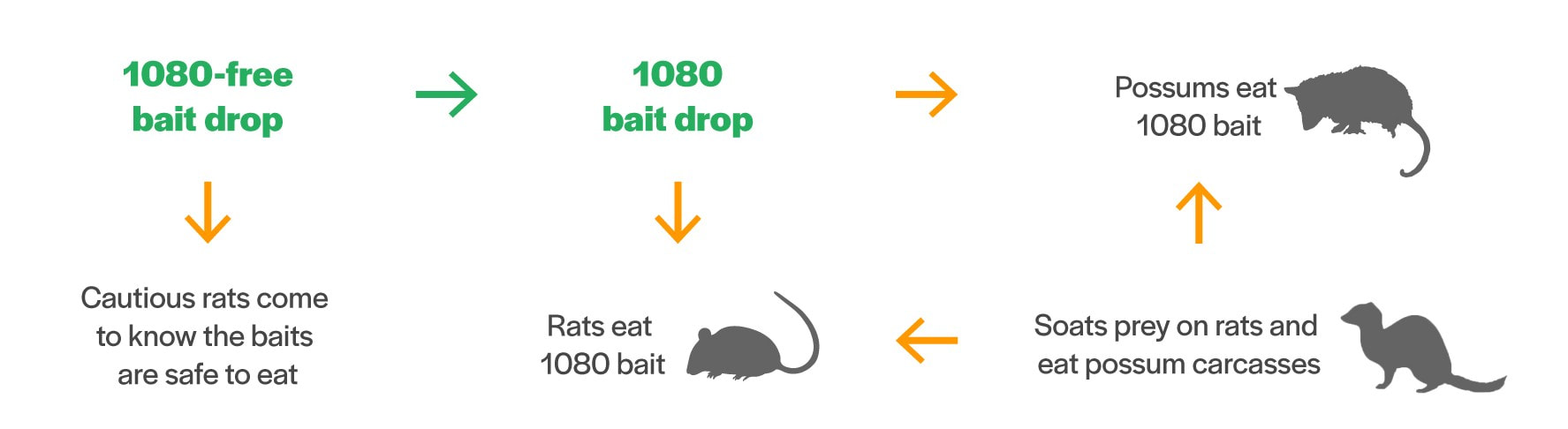
Aerial 1080 operations involving pre-feeding of baits are increasingly reliable in achieving high kills not only of possums but also rats and stoats via secondary poisoning. This’ triple hit ‘of the three major bird predators over a large area provides a breeding’ window ' that is crucial to increasing female and chick survival.
Aerial 1080 operations involving pre-feeding of baits are increasingly reliable in achieving high kills not only of possums but also rats and stoats via secondary poisoning. This’ triple hit ‘of the three major bird predators over a large area provides a breeding’ window ' that is crucial to increasing female and chick survival.
References:
[1] Fisher. P, (2008) Letter of evidence before the Waitangi tribunal in the Matter of the Whanganui Inquiry WAI 903 , Landcare Research, New Zealand
[2] de Moraes-Moreau, R. L.; Harguich, M.; Harasuchi, M.; Morita, H.; Palermo-Yeto, J. (1995) Chemical and biological demonstration of the presence of monofluoroacetate in the leaves of palicourea marcgravii . Brazilian Journal of medical and Biological Research 28, 685-692.
[3] http://www.pnas.org/content/93/24/13699.full.pdf
[4] http://www.pce.parliament.nz/assets/Uploads/PCE-1080.pdf
[5] Beausoleil, N. J., Fisher, P., Warburton, B. and Mellor, D. J. 2010. How humane are our pest control tools? Part 1. Vertebrate toxic agents and kill traps in mammal species. Unpublished report prepared for Biosecurity New Zealand
[6] Sharp, t and Saunders, G (2008). A model for assessing the relative humanity of pest animal control methods. Australian Government Department of Agriculture, Fisheries and Forestry, Canberra
[1] Fisher. P, (2008) Letter of evidence before the Waitangi tribunal in the Matter of the Whanganui Inquiry WAI 903 , Landcare Research, New Zealand
[2] de Moraes-Moreau, R. L.; Harguich, M.; Harasuchi, M.; Morita, H.; Palermo-Yeto, J. (1995) Chemical and biological demonstration of the presence of monofluoroacetate in the leaves of palicourea marcgravii . Brazilian Journal of medical and Biological Research 28, 685-692.
[3] http://www.pnas.org/content/93/24/13699.full.pdf
[4] http://www.pce.parliament.nz/assets/Uploads/PCE-1080.pdf
[5] Beausoleil, N. J., Fisher, P., Warburton, B. and Mellor, D. J. 2010. How humane are our pest control tools? Part 1. Vertebrate toxic agents and kill traps in mammal species. Unpublished report prepared for Biosecurity New Zealand
[6] Sharp, t and Saunders, G (2008). A model for assessing the relative humanity of pest animal control methods. Australian Government Department of Agriculture, Fisheries and Forestry, Canberra