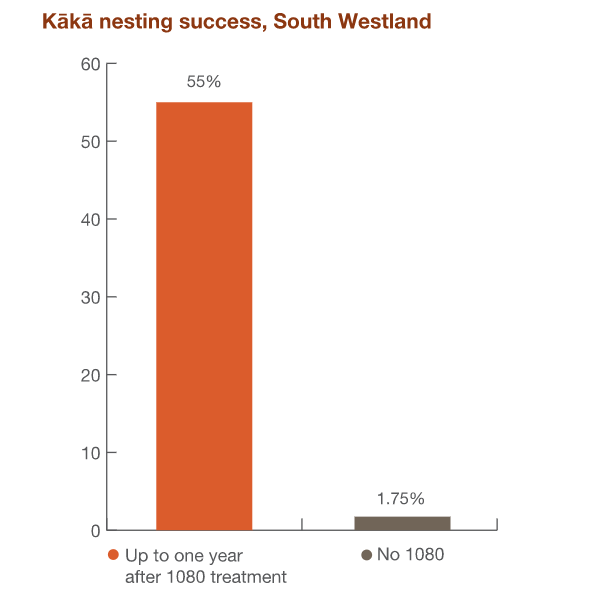
Results show on average 55% of kākā nests were successful up to a year after 1080 treatment but less than 2% of nests produced chicks in the comparison area.
This result meant that 30 times as many kākā chicks were produced in the area after 1080 treatment as the area where no 1080 was used. Adult birds also had a much higher survival rate in the area where predators were controlled with 1080.
This result meant that 30 times as many kākā chicks were produced in the area after 1080 treatment as the area where no 1080 was used. Adult birds also had a much higher survival rate in the area where predators were controlled with 1080.
Only 3% of adult kākā died in the 1080 treated area, whereas 20% died in the area that wasn't treated.
This result is significant for this relatively long-lived parrot.
The research at Lake Paringa backs up another long-term DOC study at Waitutu Forest in Fiordland that showed kākā making an extraordinary recovery after more than a decade of pest control.
This result is significant for this relatively long-lived parrot.
The research at Lake Paringa backs up another long-term DOC study at Waitutu Forest in Fiordland that showed kākā making an extraordinary recovery after more than a decade of pest control.
For more information visit the Department of Conservation website here
 RSS Feed